By Macon Holt
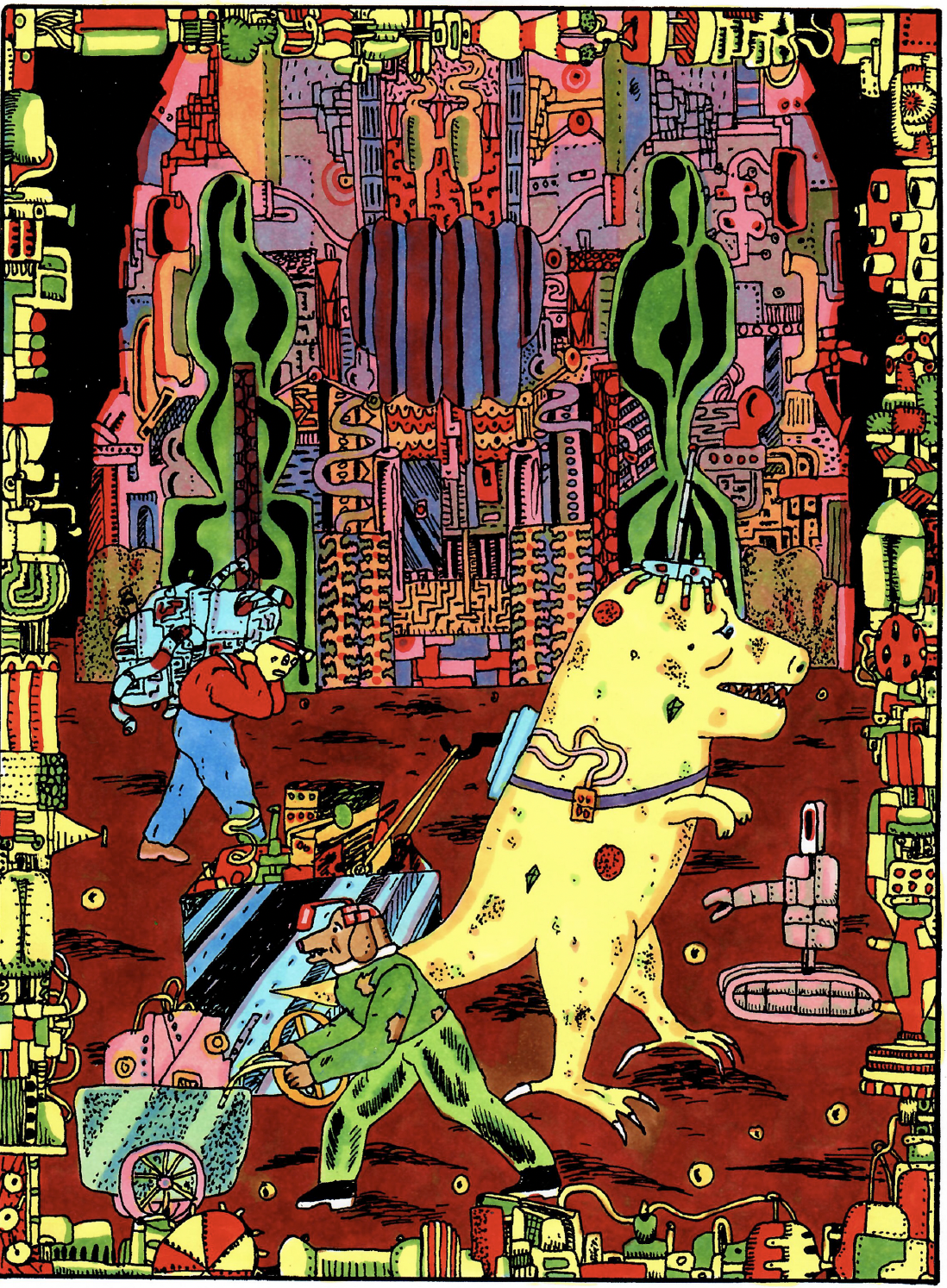
Anyone familiar with the cover of my book should know that I adore the work of Joakim Drescher. And there is a good chance you have admired it too. So the occasion of the publication of the third part of his Motel Universe trilogy is the perfect moment to give his work the attention in writing it has long deserved.
There is a temptation when you get into a body of work like Motel Universe to focus only on the critical themes of exploitation, colonial and class violence, and anti-democratic techno-media monopolies that give the work its academically legible bite. And this is important stuff that Drescher, both subtly and directly, weaves into his work. But a critical appraisal of Motel Universe should not do this in a way that downplays the playful and accessible form and aesthetic that Drescher has chosen to work in. The pages of these novels vibrate with the propulsive enthusiasm of adventure comics; They produce images that haunt and titillate and tease the readers’ psycho-sexual fantasies; And with the ghost of Caligula, no less, and Barton Flump (a comically small Donald Trump parody whose sleazy property, entertainment and leisure complex gave the series its name) as the cartoon villains of this universe, these novels make you laugh as the deadpan delivery of evil makes plain a sense of justice, injustice and absurdity that should be obvious to everyone and yet is so often ignored.
The Motel Universe trilogy charts the reversal of fortunes between two alien races, The shimmering, sandy and constantly aghast, Skins, and the gormless helmeted pig dogs, Jeffs. At the start, we find the Skins on the run as their skin is a sought-after material. With the Skins the innocent hunted victims, we assume the Jeffs, who pursue the them on behalf of their paymasters like Caligula, to be malicious and useful idiots. However by the end of part two, as Caligula convinces the Skins to take revenge by hunting the Jeffs, we start to see them for the scared puppies they have been all along. At the same time, the Skins who had so far been the underdogs are revealed to be capable of cruelty we had previously thought to be the preserve of the Jeffs. There is something of a historical move going on here. The oppresser becomes the opressed as time moves on. However, the level Drescher takes it to by showing how such reconfigurations take place stops this story from falling into a lazy misanthropy. Indeed, even as many Jeffs and Skins perish before uttering a word, we always meet some discontent with the way of things, even if it is their final thought. There is still resistance even or perhaps especially when it cannot win. This ever present forlorn resistence further complicates the switch we see in part two. The focus here is on the story of the bounty hunter, Clara Constellation, and her crusade to overthrow the Faschion empire (a society of rich techies that live in VR and keep up with the trends dictated by the algorithm and enforced by the faschion police). In so doing, this story reveals the machinations of power that can manipulate those who were once oppressed to be oppressors themselves as Caligula opportunistically uses his influence to manipulate the Skins to seek revenge on the Jeffs. This is not human (or Skin or Jeff) nature. It is the nature of the consolidation of naked merciless power.
Part three, then, looks at the next move of the powerful. Once the population is brought under control by focusing on an external enemy, the Jeffs, the Skins too become the victims of big pharmaceutical companies looking to drain their money and lives right out of them. Through irony, slapstick, and some heart-on-your-sleeve humour, and by way of Caligula’s ghost, Drescher helps us to see the true spectre that haunts the motel universe. Caligula is capitalism. Veracious, callous, cunning yet ignorant, fickle and opportunistic, sadistic and yet charming, Caligula constantly tries to undo the bonds that structure the lives of those on the planets he infests so he can extract evermore from them. And, as a ghost, he is unkillable. He can only ever be held at bay and struggled against. And even then, only for a time.
It’s not enough to say sci-fi is about the times in which it is written. In Drescher’s case, it is clearly also about how our times bear a disconcerting resemblance to the 1920s and 1930s, in the sense of a tension that is building. Thus his work perhaps is a surreal imagining of where the next world-altering rupture to follow such tension might lead. And while there may be parachutes around him that he could reach for as an artist – he could sharpen his elbows and aim for a blue chip career – through these works he has stayed with the worries and the worried. While not cheap and trashy, Drescher has made three spectacular volumes of gorgeously realised graphic art in one of the most accessible forms he could choose to work in, comic books. And in doing so he has taken some of the complex analysis provided by traditions like Marxism, psychoanalysis, the critique of racial capitalism, the critique of the carceral state and big tech and big pharma, and made it an immediate, imaginatively rich adventure into a universe that, for all its horrors, is just so damn exciting you can’t help but want to linger in it longer. This has been a democratic project for Drescher, which we are lucky to be able to hold in our hands.
The work of Joakim Drescher is a dedicated and rigorous flailing that gives comfort, in the words of Kodwo Eshun, to “those of us unable to reconcile themselves to their existence; those of us who’s dissatisfaction and disaffection, who’s discontent, who’s anger and who’s despair overwhelms them”. If the pages of these books are anything to go by, then, over the course of the Motel Universe trilogy, Drescher has been overwhelmed too. He has also felt how overwhelmed those around him, his community, have been by a world that is, by all appearances, indifferent to the dream and promise of freedom. But this dream and promise were, it seems, only ever a mirage used to justify this world’s capitalist economic theology. The indifference to life in the pursuit of wealth can be all too much to bear. And yet, the courage of Drescher’s work lies in the fact that, on many levels and in different ways, it refuses the panicked impulse to lie down and die that might be engendered by such an overwhelming indifference to the beauty and fragility that makes up these lives of ours. In this way, the Motel Universe is animated by another spectre. The spectre of, what Herbert Marcuse called, “the world that could be free”. And what this spectre brings forth on the page and in the graphic novels’ readers is a desire for that struggle to be fought. Faught for all the noble reasons already mentioned but mainly because Drescher knows how to have fun.
You can find more of Joakim Drescher’s work and get in touch at @joakimdrescher.
The Copenhagen Launch will take place on August 25th at Super.cph from 16-20
 MaconHolt - Aesthetic Theory
Leave a comment