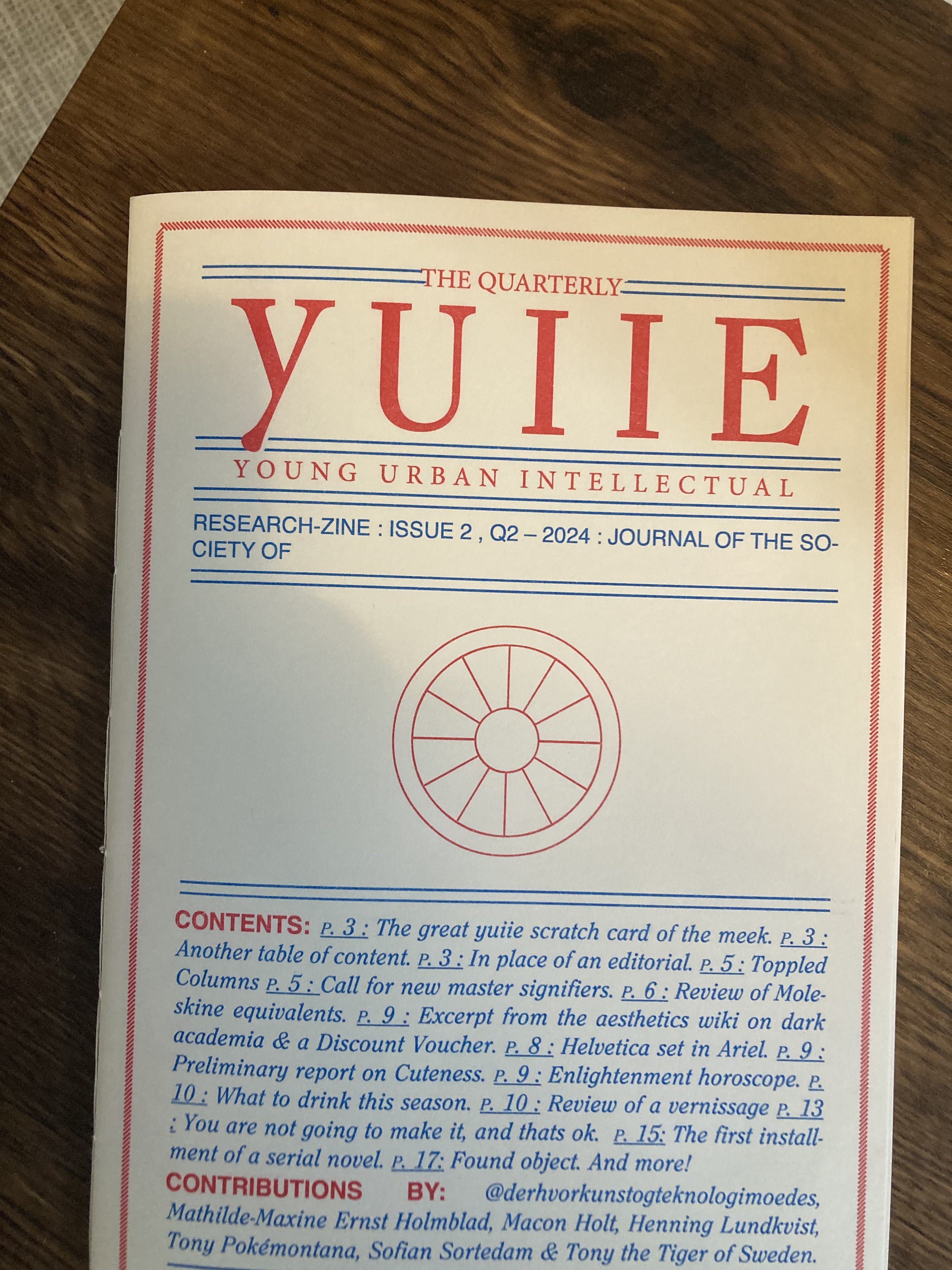
First Published in YUIIE issue 2.
“Oh, hope there is plenty, infinitely much hope, just not for us.“
– Max Brod remembering something Franz Kafka might have said to him.
You are not going to make it, and that is ok. Many people are not making it in profound ways already and that is far from ok. This statement is not meant for them. This statement is for those who labor under the idea that they will, or perhaps should, make it. Whatever it is. Maybe those that need to hear this are many of the readers of this publication. Maybe the author of this piece too. But to go beyond the self-flagellation that we on the left are so very good at (although never quite good enough), this condition, this laboring under the misapprehension that you are going to make it has been theorized as a part of the general condition of late capitalist life for some time now in various different forms. One of the most compelling of which is as, what the late Lauren Berlant called, “cruel optimism”. Here, I want to tarry with the contention Berlant made in the book that such cruel optimism might be better than no optimism at all. And suggest that this might only be true if it is in tension with its opposite, which we could call kind pessimism.
Berlant claimed that “a relation of cruel optimism exists when something you desire is actually an obstacle to your flourishing”[1]. Meaning, cruel optimism is not an individual delusion about a unattainable object, but a relational experience that articulates your desire through socially and culturally specific means but which structurally remains out of your reach. A simple example of this is the atrophying cliché of the American dream in the conditions of post-financial crisis neoliberalism. Or the idea that through hard work one can achieve “the good life” as defined by the markers of taste, commerce and normative, gendered and racialized pressures, which has, empirically speaking, been shattered by the carnage wrought upon the global economy by financial capital. And yet for many, it seems impossible to desire otherwise. This leads to an experience that Berlant calls an impasse in which desire is disconnected from the meaningful action for its realization. At the same time, the libidinal force that constitutes this frustrated desire is constantly stoked, leaving many in a holding pattern laboring to continue being able to desire what can’t be attained.
A radical leftist could be tempted to dismiss all this as merely the trap of bourgeoise desire. Moralistically, they could claim this is the result of wanting what you can’t have because capitalism is structured by constructing and enclosing what is desirable. The sensible thing then is to desire a world in which capital has been abolished and “we” can “realize” “our” desires. In a sense, this is not wrong. But I argue there is something more fundamental going on that is common to both bourgeois and revolutionary desire. I would wager many of those who entered leftist politics in their youth could attest that there is something toxic about revolutionary fervor as it can trap you in a situationship with the receding horizon of the near future and blind you to all that is worthy of your of love and labor in the present. Thus the bourgeoise PowerPoint jockey and the ineffectual revolutionary have the same formal relationship to desire that ensures nothing can ever change, least of all themselves. It is not just that you want what you can’t have. It’s that the you that wants is transformed by wanting in this world to the extent that your wanting transforms the world.
Isabelle Stengers points to what she sees as an equivalence between ‘agency – or what Deleuze and Guattari call “desire”’[2]. Deleuze and Guattari challenged the conception of desire put forth in psychoanalysis as something produced by a prior lack and argued instead that desire is more like an action that is productive of the real[3]. This equivalence between desire and the agency that produces the real is, then, apparently contradictory to the desire that Berlant describes as cruel optimism, which has us stuck in an impasse forever circling the lack. But what if this were not quite the case? What if the desiring that produces the real could produce the experience of lack? What if the desire of cruel optimism was itself also productive of something, namely the impasse? That perpetual lack machine that holds the subject of desire in place through their experience of themselves as stuck. If so, then the desire/agency that is being exerted is a form of identity protection. A way to hold on to the hope that you will get what you want and be able to enjoy it by never letting it, or anything else, happen. You are defined as “perpetually going to make it”, and so you must never let that happen or anything else.
In a talk once, a student of Stengers, Martin Savransky, called for what he termed “irreverent pessimism”[4]. He argued that such an orientation was only possible if one were to live “a life without appeal”. That is a life without a gesture to a pre-determined beyond to serve as its justification. That is a revolt without a fixed future and certainly without redemption. A life without appeal would be one in which you, in the present, improvised through attachments and joys and struggles that could build the socialities that facilitate the freedom to be and become otherwise. A life in which your desiring was less concerned with maintaining you as the unit of its experience and instead let you invent what else you might become through encountering others. Rather than irreverent pessimism, then, I call this kind pessimism. Kind because it offers a subject relief from the frantic scurrying to maintain a rigid identity. An escape from a subjectivity that cannot allow itself to be affected by what is, while being trapped in its affected condition. Pessimism because, for the subject at the center of such an orientation, the future is inherently dangerous because the future is not for that subject. In allowing itself to be affected, that subject consents to its annihilation, like the symptom that consents to take itself to analysis.
But of course, it is not enough to say you just have to let go. Letting go requires a stability that is structurally and physically unavailable to so many. It must be recognized that the impasse is also a holding pattern that holds what nothing else can or will. Cruel optimism can produce the stability that many need to survive the other cruelties of this world of extractive capitalist realism when nothing else is on offer. If there is an ethics, then, of how cruel optimism and kind pessimism relate, it might be hinted at in Berlant’s final book, “On the Inconvenience of Other People”[5]. Whether it be falling in love, being cut off in traffic or struggling against oppression, encountering others destabilizes the subject that would hold on through its lack. Berlant describes this destabilization as bringing about an “affirmative brokenness”[6], suggesting that even as we are disturbed and coming apart doing so affirms something, however incompletable.
So perhaps, as cruel optimism and kind pessimism pull against each other, it is less annihilation we consent to but, to quote Kodwo Eshun, quoting Fred Moten, quoting Eduard Glissant, it is to “consent not to be a single being”[7]. Or as Savransky puts it “consenting to join in the adventure” albeit with “no romanticism, no promise of salvation, and no guarantee of safety or peace”[8] but consenting all the same and allowing for “the trembling of togetherness [to grant] the power to transform our stories and concepts, to let oneself be transformed by them”[9]. Even though you are not going to make it you can make it that someone else will. There is hope just not for us. In negotiating the spaces between cruel optimism and kind pessimism and by affirming the brokenness, those you help to make it might be more like you than you ever could have desired.
[1] Berlant, Lauren. Cruel Optimism. Duke, 2011, p. 1
[2] Stengers, Isabelle, “Reclaiming Animism.” E-Flux. 36, 2012, p. 6
[3] Deleuze, Gilles and Felix Guattari, Anti-Oedipus. Bloomsbury, 2013, p. 39
[4] Savransky, Martin, “A Life Without Appeal?: For an Earthly Ensemble of Uncivilized Feelings.” Earth Sensations, Aarhus Institute of Advance Studies, 2022.
[5] Berlant, Lauren. On the Inconvenience of Other People. Duke, 2022.
[6] Ibid p. 171.
[7] Eshun, Kodwo. Kodwo Eshun: Mark Fisher Memorial Lecture. 2018. https://www.youtube.com/watch?v=ufznupiVCLs&t=1646s&ab_channel=DepartmentofVisualCultures%2CGoldsmiths
[8] Savransky, Martin. Around the Day in Eighty Worlds. Duke, 2021. Pp.92–93.
[9] Ibid p. 22.
 MaconHolt - Aesthetic Theory
Leave a comment